
Images captured by neighbors in Downey show the moment when two gardeners were about to be arrested and put into a vehicle by immigration agents. However, the arrest did not take place thanks to the intervention of the community.
The incident occurred on Saturday morning, January 10, near Benares Street and Ryerson Avenue. In the video you can see how the neighbors react immediately, take out their phones and start recording. As officers struggled to apprehend the gardeners, neighbors questioned their actions and demanded they be released, eventually leading the officers to retreat and release the two men.
The moment has been celebrated on social media and in rapid response groups, as well as by other vigilantes, who point out that the incident showed how valuable it is to raise your voice and unite when a situation like the one recorded in Downey occurs.
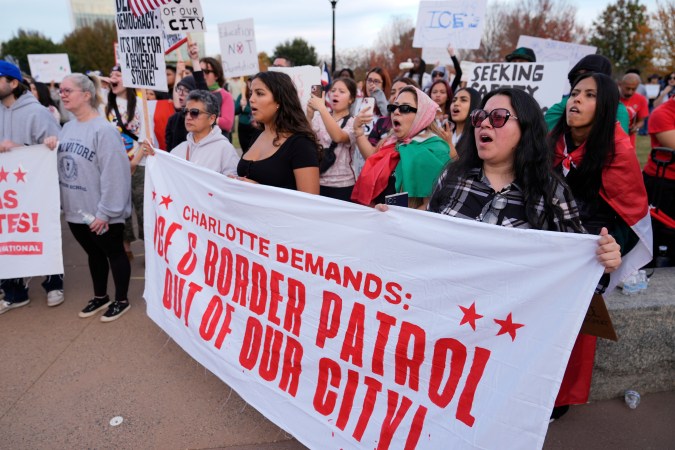
The groups insist that one of the most important and effective things for someone who wants to help their community is to join groups and organizations that train them to be neighborhood watchers. They say that being prepared translates into actions like the one that occurred last Saturday.
“The success of the defense of communities against ICE depends on two things: an organized community, willing to come out together in large numbers and demand that their rights not be taken away from them,” said Guadalupe Cardona, an organizer with Unión del Barrio, one of the first groups that called for surveillance of their communities. “Success also depends on whether or not officers take advantage of the impunity they have been granted, or whether or not they follow “legal” orders with court orders.”
The moment captured, which continues to circulate on the networks, is not the first case in which the community, together with rapid response groups, has managed to chase away immigration agents.
In June, during the height of the raids, video captured a moment in the city of Bell when community members protesting ICE clashed with agents who had arrived in their neighborhood. At the time it was said that thanks to a fire truck that was blocking the officers and the community from entering, they were able to get the officers to turn back and leave the city.
In September, Orange County’s rapid response network, together with the community, was able to deploy officers who were stationed very close to a car wash where a raid had previously occurred. After the group made a live broadcast on their social networks to alert the community about the presence of agents, people who lived nearby arrived at the scene to demand that the agents leave and they did. Nobody was arrested.
At the time, Sandra de Anda, who is part of the Orange County rapid response group, said that the success in stopping that possible raid was due to the quick response of the community. Restaurants and other businesses in the area acted quickly and closed their doors, while other people monitored the officers’ movement.
“It is critical to question ICE when they are present in your community. Although they claim to enforce the law, they often lack basic knowledge of immigration law itself, reflecting an enforcement model that prioritizes blind compliance over critical analysis,” de Anda said.
“We have seen that when people know and assert their Fourth Amendment rights, they are often better able to avoid interaction with these agencies, whose tactics have become increasingly violent and dehumanizing. This, in turn, reduces the number of people detained.”
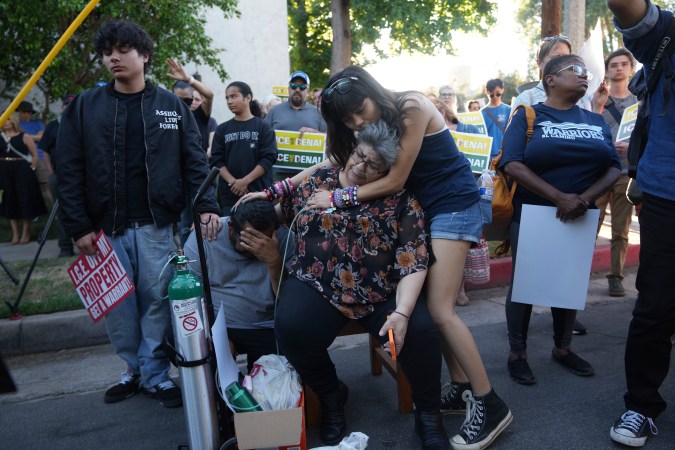
There are some advocacy groups urging the community not to be consumed by fear after the murder of Renee Nicole Good by an immigration agent, since she was a vigilante. During a vigil and protest in Boyle Heights last week, organizers from several advocacy groups called on the community to join vigilante organizations and teach them how to police carefully. Declaring that it is the only way to avoid more arrests.
“This requires prior organization, with established communication channels, so that when one person confirms an ICE raid, many more come,” said the Unión del Barrio organizer. “It requires people to know their rights. And it also requires those of us who respond to keep our distance and not physically intervene.”
“Many of the agents are untrained and respond to their primitive emotions and not the law, especially because they know that the federal government will allow them to break the law with impunity,” he added.
They even say that just documenting an encounter helps family members and defenders a lot to identify detained people. Something about giving your family members relief also helps connect them with resources to help with your case.
“This ensures that people do not disappear into the system and that they are supported by a community-based legal defense,” de Anda said.
Advocacy groups say documenting raids or attempted arrests by ICE is important because it can also help people when they sue authorities or have their rights violated, whether they are citizens or not. Like in the case of the gardeners in Bell, who presented their green card and a valid work permit, but they still tried to stop them.
“Since the escalation of enforcement efforts involving multiple agencies within the Department of Homeland Security—including Border Patrol, Immigration and Customs Enforcement (ICE), Homeland Security Investigations (HSI), in collaboration with the Department of Justice and federal marshals—we have witnessed countless unlawful detentions and violations of individual rights,” de Anda said.
Courtney Cook, an activist with the Orange County Rapid Response Network and ICE Out of Garden Grove, said she has seen firsthand the importance of community involvement.
She is a community watchdog, is part of a center at the Home Depot in Garden Grove, and along with other volunteers patrols the area and has established a close relationship with the day laborers.
He emphasizes that working with migrant workers has taught him that helping the community can be done in different ways.
“There is power in numbers, which is why we have established long-term community advocacy centers in vulnerable locations, like outside Home Depot stores,” Cook said.
“Sometimes protecting people from kidnapping means taking them home, providing food or hiring someone for a day. Showing people that we will be there before, during and after a raid has built trust and now affected people have more resources than before.”
For now, organizations are preparing for actions planned for the first anniversary of Trump’s presidency. But they remind people that while going out and protesting is important, what they do in their immediate communities and policing their local communities is even more important.
“We cannot allow these types of activities to become normal,” Cook said. “No one deserves to be deprived of their life, and if we allow this to happen in the background, while we continue with our daily lives, we become complicit.”