
A plate of turkey dressed with mashed potatoes, macaroni soup, cranberry sauce and green beans made Abraham Soto forget the sorrows of life, who was about to be another victim of the cruel immigration raids.
On August 6, Soto, 63, originally from Retalhuleu, Guatemala, and his grandson Erickson Elian Pérez went to a Home Depot store in the area of Union and Westlake streets to buy construction materials.
“They didn’t catch me or my grandson, but they chased Elian and he jumped a fence and fell 10 feet into the void,” Abraham said. “My grandson broke his ankle in two and the doctors had to put platinum and nine screws in.”
That day, at least 30 Immigration and Customs Enforcement (ICE) agents arrived at the Home Depot area.
“We were going to get some material and the agents came out everywhere,” Abraham recalled. “When I left the store I didn’t see my grandson anywhere.”

Erickson Elian Pérez had crashed on the cement floor. Fortunately, because of the serious fracture, the ICE agents stopped pursuing him when they realized that he was injured.
“They didn’t go for him anymore,” said Abraham, who reported that his relative already had his cast removed and is doing exercises; although he still can’t walk well.
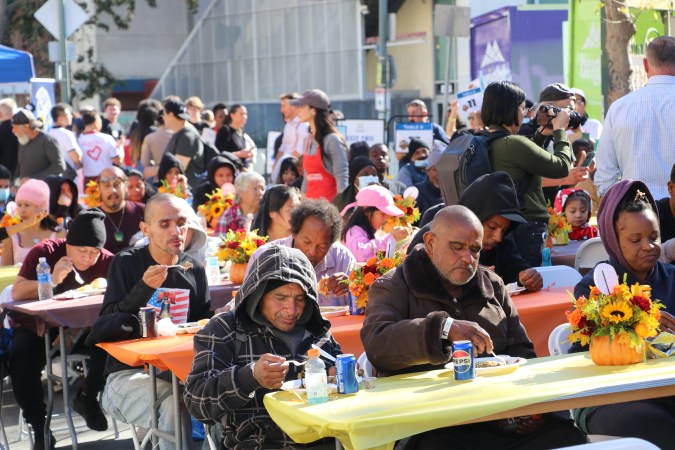
Abraham Soto and his wife, Aura Dueñas de Soto, were among approximately 2,500 other people who lined up early Wednesday to receive a Thanksgiving lunch hosted annually by the Los Angeles Mission.
Since 1936
Since its founding in 1936, the Los Angeles Mission has offered Thanksgiving meals, first as a soup kitchen during the Depression era and has continued this tradition, serving special meals to those most in need in Los Angeles society.
“This year was very difficult. Many people are suffering. They don’t have food,” declared Mayor Karen Bass, who, after serving almost a hundred dishes to diners, shed a few tears.
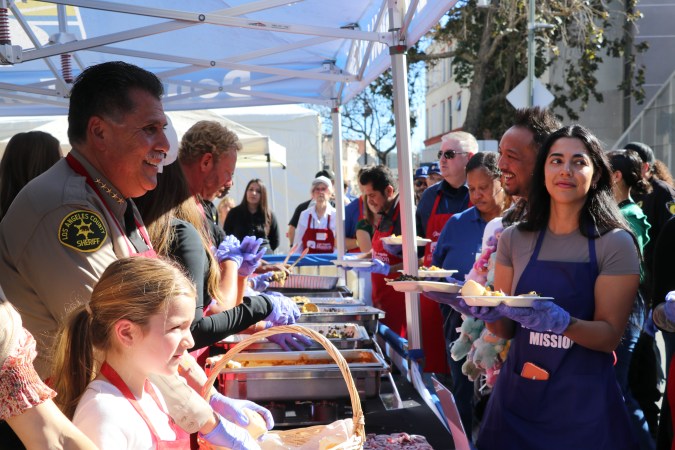
“We must never forget the people who are hungry every day,” he explained.
Many people were also suffering and expressing fear over the immigration raids that are still ongoing in the city and county of Los Angeles and continue to break up families.
“It is something that continues to happen and I hope that [las personas] Have faith that everything, one of these days, will return to normal,” Bass said.
Verónica Bernáldez, who transports food to care centers for the homeless, announced that three members of her Church of the Americas were arrested for immigration in recent months.
“As far as I know, they haven’t been deported yet,” he said. “They have them in [el centro de detención de ICE] Advance, but the truth is that his family members are very stressed and sad.”
Ms. Bernáldez told La Opinión that she does not agree with the way people are being mistreated by ICE agents throughout the country.
He stated that the way to avoid being humiliated and being deported would be “for all the people who come to the United States to come academically prepared and speak English, but among immigrants there is everything, some are hard workers and others come just to come.”
Thanksgiving at the Los Angeles Mission is more than a meal, as chef Erik Grant defines it.
“It’s a celebration of warmth, connection and caring, with lots of sauce, ice cream for everyone and a touch of joy,” said Grant, whose team cooked 1,600 kilos of turkey.
In addition to the main dish, the cooks prepared 270 kilos of macaroni, 350 liters of cheese, and 225 kilos of cabbages.
Feed those who are hungry
Denis Oleesky, acting executive director of the Los Angeles Mission, said he was happy to feed thousands of people, “but it also hurts to see the level of pain here.” [entre la gente]”.
“I see the pain and suffering of the people I know who have been living on the streets. It’s hard to imagine where these people will be tomorrow, when no one gives them food. That’s what I think.”
Asked about the Latino families who came for a plate of food on Thanksgiving Day and who have been direct or indirect victims of seeing that a family member has been deported, he said: “My heart goes out to all the families who have missing relatives, and I just want them to know that we will continue fighting until their relatives return.”
Oleesky commented that he is happy with each day he works at the Los Angeles Mission, although for the people who came to receive a plate of food, “this could be the worst day of their lives, [por saber que no tienen nada]but a simple greeting, a simple recognition and a dignified treatment can mean a lot. It could mean that we stop a suicide today or that we keep them away from dangerous places. So whatever we do to help these people, we are here to do it, and we do it every second of the year.”
The manager emphasized that the people who live in the Skid Row area, and in particular those who receive services and help from the Los Angeles Mission, “are the most fantastic people on the planet and the most grateful in the world.”
He acknowledged that among the people in the huge line there were those who were nervous for fear of being deported, despite living legally in the United States.
‘It’s sad. It’s scary to think that the most marginalized people have to worry about anything other than: where am I going to eat? Where am I going to sleep? How am I going to do this tomorrow? It’s just one more thing to think about, and it’s really unfortunate,” he explains. “In the Los Angeles Mission we are dedicated to service,” Oleesky stressed.
“So we don’t ask questions. If someone is hungry, we feed them. If someone needs a place to sleep, we give them a pillow. We are just here, literally, to serve anyone of any form, race, religion or citizenship. To me, the important thing is that we take care of these people.”
Precisely, those who did not worry the most about the lack of food on Thanksgiving Day were Julio Gómez, a 49-year-old from Veracruz who is unemployed, and his partner, Verónica Delgado, originally from Guadalajara.
“I stopped working for fear of raids. They took two of my friends from a Home Depot on Western and Sunset streets,” said the immigrant. “I wouldn’t want them to deport me. I’m afraid and because I’m thinking and thinking I can’t sleep.”
“What is happening with the raids is too sad,” Verónica added. “We come from our countries with the dream of improving ourselves because the situation there is difficult, but right now we are living worse here.”
He adds that in Mexico they are low-income people, but they do not receive so many blows, so much humiliation.
“Here we come and they even treat us as if we were worse than criminals,” he emphasizes. “I think that people who come out of prison are given more opportunities than those of us who are working decently and honestly.”