
The dispute over the implementation of a treaty signed in 1944 that regulates how the United States and Mexico should share the water of the Bravo and Colorado rivers is intensifying again.
President Donald Trump announced this Monday that he gave the green light to the documentation to impose a 5% tariff on products from Mexico if the neighboring country “continues to breach” the treaty.
In a message published on his Truth Social network, the president stressed that Mexico owes more than 986 million cubic meters of water to the United States and established December 31 as the deadline for Mexico to deliver more than 246 million cubic meters of water.
“The longer it takes for Mexico to release the water, the more harmed our farmers will be,” Trump warned, urging Claudia Sheinbaum’s government to “solve” the issue now.
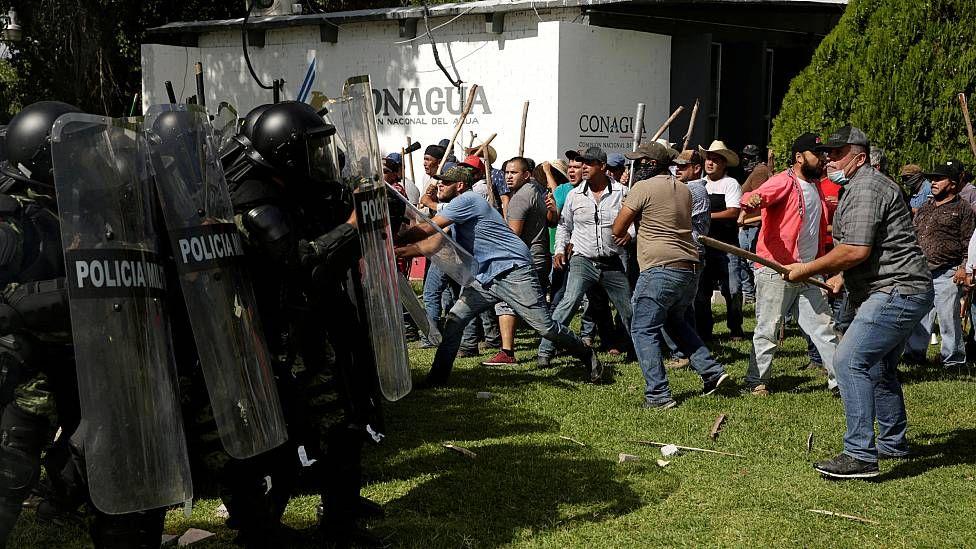
The implementation of the treaty has in the past generated strong protests from Mexican farmers, according to whom the extraction of water for the United States is unacceptable. In times of drought it seriously threatens their livelihood.
In April, Trump had already threatened Mexico with tariffs and even sanctions over the water issue.
“Mexico is failing to fulfill its obligation. This…seriously harms the farmers of South Texas,” Trump then wrote on his Truth Social platform.
“Last month I stopped water shipments to Tijuana until Mexico complies with the 1944 Water Treaty… and “We will continue to escalate the consequences, including tariffs and, perhaps, even sanctions, until Mexico complies with the treaty and gives Texas its rightful water,” he added.
The president of Mexico, Claudia Sheinbaum, responded to Trump at that time with a message on her official X account.
“Yesterday, a comprehensive proposal was sent to the Undersecretary of the United States Department of State to address the shipment of water to Texas within the 1944 treaty, which includes very short-term actions. There have been three years of drought and, to the extent of water availability, Mexico has been complying.”
“I have instructed the Secretaries of Agriculture and Rural Development and Foreign Affairs, as well as the Secretary of Environment and Natural Resources to immediately contact the Secretary of Agriculture and the Department of State of the United States government. I am sure that, as on other issues, an agreement will be reached,” the president said in April.
What does the treaty say?
In some way, it could be said that the so-called Treaty on the Distribution of International Waters signed by Mexico and the US in 1944 has its origins in another agreement reached almost a century before that date.
The Treaty of Peace, Friendship, Limits and Definitive Settlement (better known as the Treaty of Guadalupe Hidalgo), signed in 1848 at the end of the war between both countries initiated by the Texas dispute, was the one that established that Mexico would cede more than half of its territory to the United States at that time.
But in addition, it also established the border between both countries at the Rio Grande – known as the Rio Grande by the Americans – and whose waters have been the center of conflict in Chihuahua.
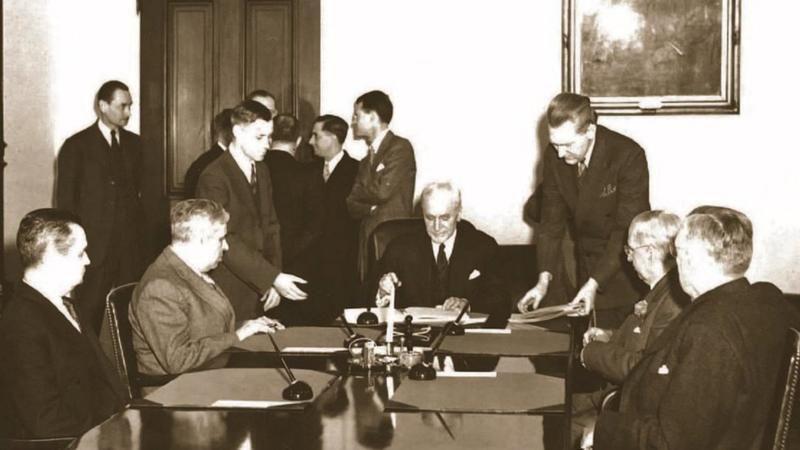
The strategic location of the river made it necessary to have a distribution plan between both actors. After years of negotiation and several failed proposals, Mexico and the US signed the treaty in force today in Washington.
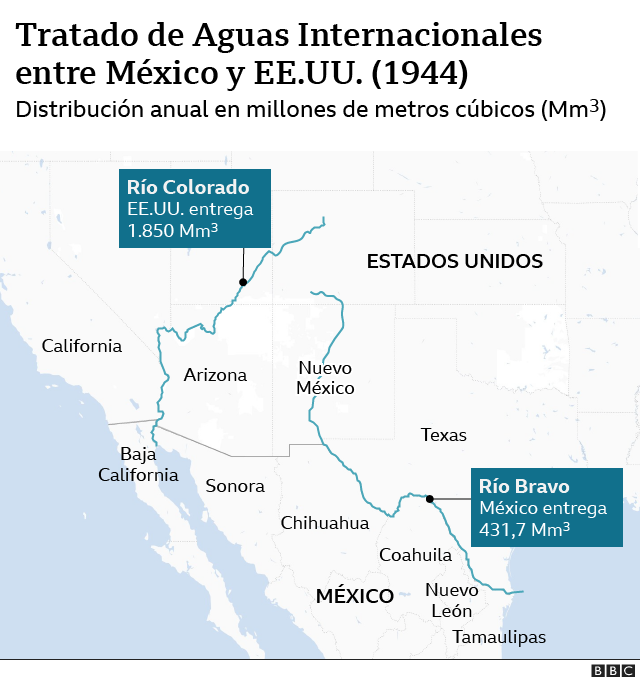
According to the agreement, Mexico keeps two-thirds of the main flow of the Bravo and cedes the rest to its neighbor, which cannot be less than about 432 million cubic meters (Mm3) annually.
As a counterpart, the US cedes to Mexico each year 1,850 Mm3 of the Colorado River, which is mostly on US soil but also passes through the border between both countries until it flows into the Gulf of California, between the Mexican states of Baja California and Sonora.
The agreement also establishes that the International Boundary and Water Commission (IBWC), a binational body, is in charge of resolving possible differences regarding boundaries.
The pact stipulates that the US will fulfill its water delivery every year, while Mexico will be able to do so in five-year periods.
“It is one of the best agreements that have been achieved in history in relation to the United States,” former president Andrés Manuel López Obrador stated in 2020.
Should the treaty be reformed?
Reforming or updating the conditions of a treaty that was signed 76 years ago could be one of the options to try to resolve conflicts.
But some analysts consider that both the agreed liters of water and the possibility of delivering its part every five years instead of annually are advantages that Mexico should not lose.
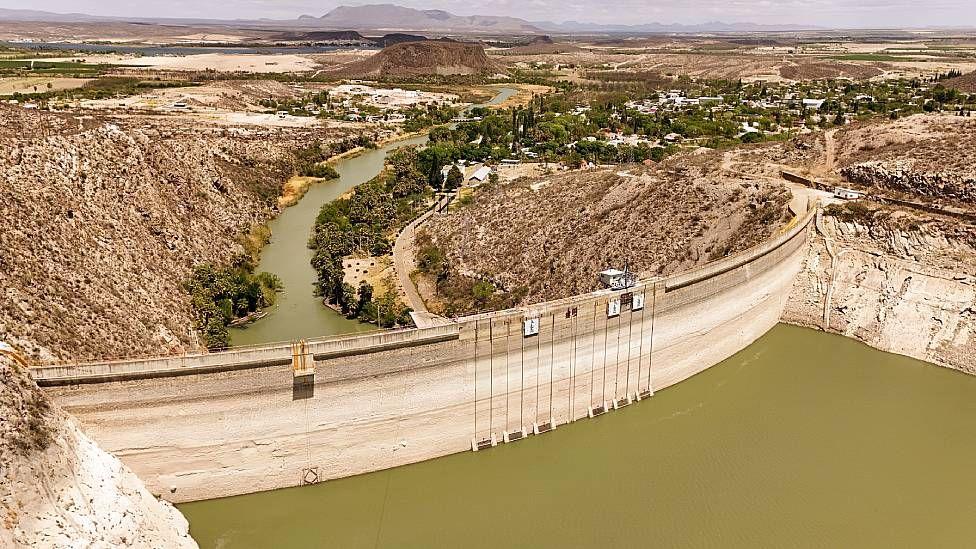
For farmers on the Mexican side of the border, the stakes in times of drought worsened by the climate changeis something much more immediate than the diplomatic ups and downs between both countries.
The 2020 clashes between farmers and the National Guard in Chihuahua took place following the government’s decision to extract water from the Boquilla Dam to comply with the treaty with the US.
At that time, the farmers’ spokesperson, Salvador Alcantar, president of the Association of Irrigation Users of Chihuahua (Aurech), pointed out that the future of some 20,000 families living off the countryside in the region was at risk.
Alcantar shared with BBC Mundo one of his biggest fears:
“In 1995 the dams were not opened for planting and there was a massive migration from our municipalities. Men of productive age left to support the family, it was a strong family disintegration that we are still suffering,” he recalls.
“And that is the social problem that we can see again if we do not plant next year.”

click here to read more stories from BBC News Mundo.
You can also follow us on YouTube, instagram, TikTok, x, Facebookand in our new whatsapp channelwhere you will find breaking news and our best content.
And remember that you can receive notifications in our app. Download the latest version and activate them.